What the tide does to steel
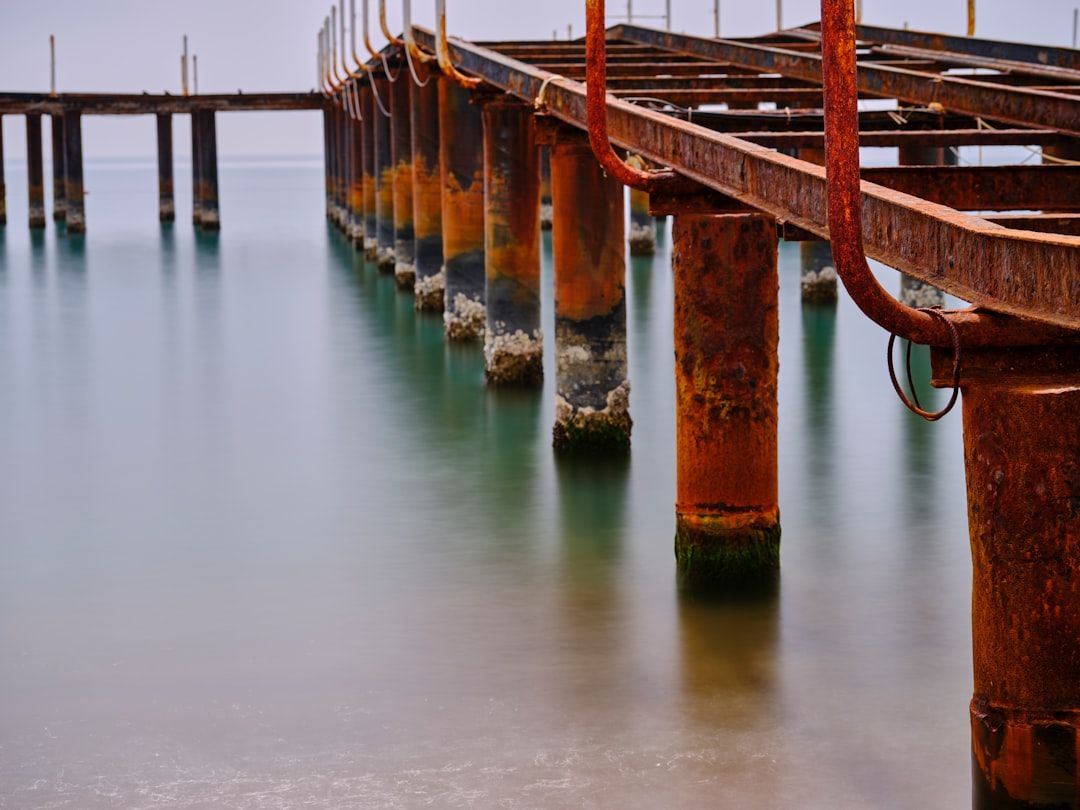
Every tide wets the steel. Every ebb dries it and leaves salt behind. Oxygen reaches the surface freely between the two. That wet and dry swing is what drives the loss, and it runs at every cycle, all year.
The loss compounds. Over decades of tidal cycling and salt spray, the strip between low water and the top of the spray thins faster than the steel above or below it. That strip is also the hardest one to see. Rope crews work above it and divers work below it. The band that goes first is the band that gets looked at least.
Why the usual answers struggle
Hot work is the first answer, and it brings an ignition source to a wellhead that may still hold residual hydrocarbons. That is a spark risk on live steel, and the permit alone can hold a job for weeks.
Paint is the second. A coating protects sound metal. It cannot put back wall that has already gone, so over thinned steel it hides the loss rather than arresting it.
Replacement is the third. Cutting out a conductor means a marine spread, lifting gear, and a shutdown built around both. That is a large job for a local problem.
The cold-bonded route
A fourth route is engineered rather than improvised. We bond rolled steel plates over the damage zone, which puts sound steel back where the wall was lost. A polymer caps the plate edges and every seam, since seams are where moisture would otherwise track in. A composite wrap then encases the whole repair.
That wrap is engineered to ASME PCC-2, the American Society of Mechanical Engineers standard for the repair of pressure equipment and piping. It is rated for permanent splash-zone exposure, so it is a repair meant to stay, not a patch to get through the next survey. No heat goes into the asset at any stage.
The repair on a conductor casing
An independent, Trinidad-focused operator had a conductor casing that had lost wall right through. The inner casing string was exposed at the corrosion site. Left as it was, the conductor risked seepage and, in time, collapse. The well had been abandoned, so the fix had to hold without a re-entry.
We scoped and executed the work in roughly one week. The repair itself took one day.
We are Trinidad’s only Belzona-certified supplier and installer. On this job we supplied the system and applied it.
Two rolled steel plates went over the damage zone, bonded with Belzona 7311. Belzona 1111 capped the edges and seams against moisture ingress. Belzona SuperWrap II carbon fiber composite encapsulated the repair, engineered to ASME PCC-2 Article 4.1 and rated for permanent splash-zone exposure. There was no welding, and the well was never re-entered.
The conductor casing was fully repaired in place, with no leaking. We painted the full asset and brought it to a like-new state. The stage-by-stage account, with the before and after photography, is in the conductor repair case study.
Worth a look before the next survey
Wall loss in the splash zone runs on a clock the tide sets, not on the survey interval. What we do in that band is set out under splash-zone composite reinforcement. If you would rather have the condition established first, send us the asset for a technical evaluation and the findings come back in writing.